Our customers have been hired at: *Foot Note


Table of Contents
Get started with MyPerfectResume today!
- Build a resume on any device
- Pick an ATS-friendly template
- Tailor with AI copy suggestions
Your cover letter can be the difference between getting noticed and getting overlooked. It’s your chance to make a memorable first impression and show why you’re the perfect fit for the role.
In this guide, you’ll find step-by-step instructions on how to write a cover letter for a job application, along with expert tips and customizable examples to simplify the process.
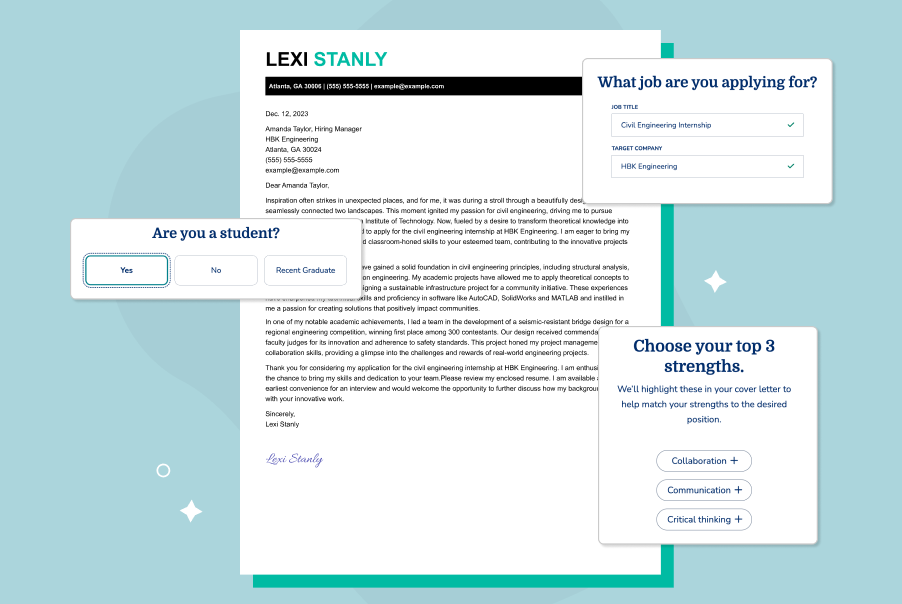
The video below shows how to create a cover letter with our Cover Letter Generator—designed for fast, polished results on any device to save time and help you stand out.

Video: Learn how to make a cover letter with our Cover Letter Generator.
Do Cover Letters Still Matter?
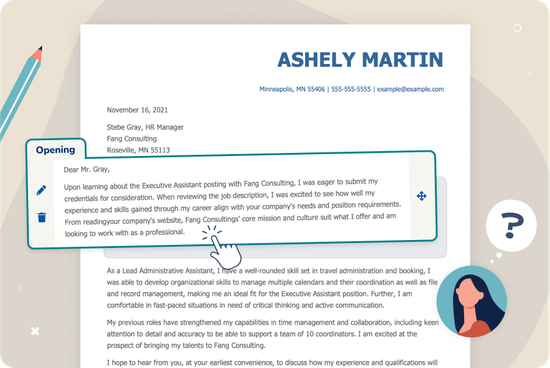
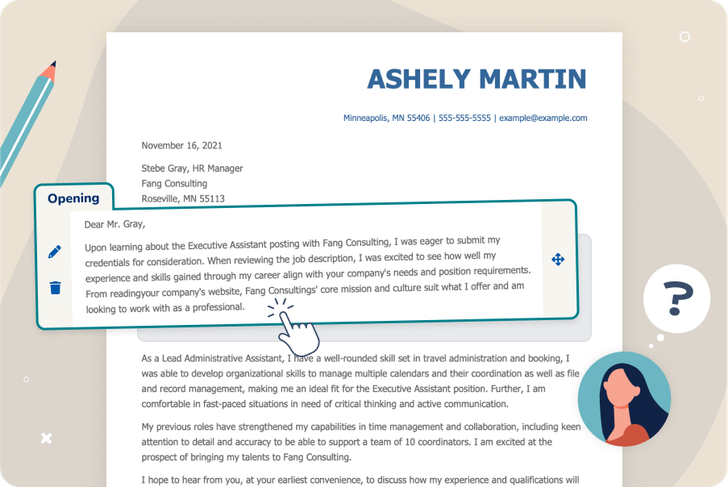
Yes, cover letters still matter in the hiring process, especially when employers want insight into your motivation, communication skills, and overall fit beyond your resume.
What the Data Says
Recent hiring surveys show that cover letters are still widely read and considered:
- 94% of hiring managers say cover letters influence interview decisions.
- 83% of hiring managers say they read cover letters even when they aren’t required.
Despite the rise of AI in the hiring process, these findings suggest that cover letters continue to play an important role in how employers evaluate candidates.
Explore our guide on the necessity of cover letters for expert insights and practical tips to help you decide when and how to include one with your application.
Why They Still Matter
Unlike a resume, which lists your qualifications in a structured format, a cover letter lets you showcase your personality, enthusiasm, and professional voice. Think of it as your sales pitch to the hiring manager—your chance to explain why you’re the right fit for the job.
Here are a few benefits of writing a cover letter:
- Introduces you professionally and sets the tone for your application
- Highlights your most relevant skills and experiences tailored to the job
- Demonstrates your enthusiasm for the role and the company
- Shows your understanding of the company’s needs and how you can contribute
- Encourages the hiring manager to read your resume and invite you for an interview
Writing a Cover Letter: What to Include
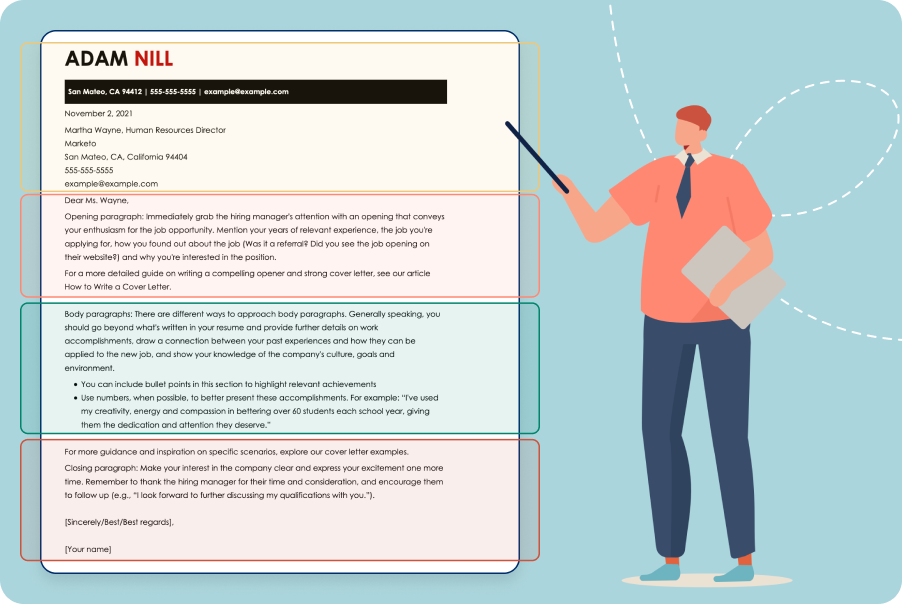
A strong cover letter should quickly explain who you are, why you’re applying, and what makes you a strong fit for the role. Here are the key elements every cover letter should include:
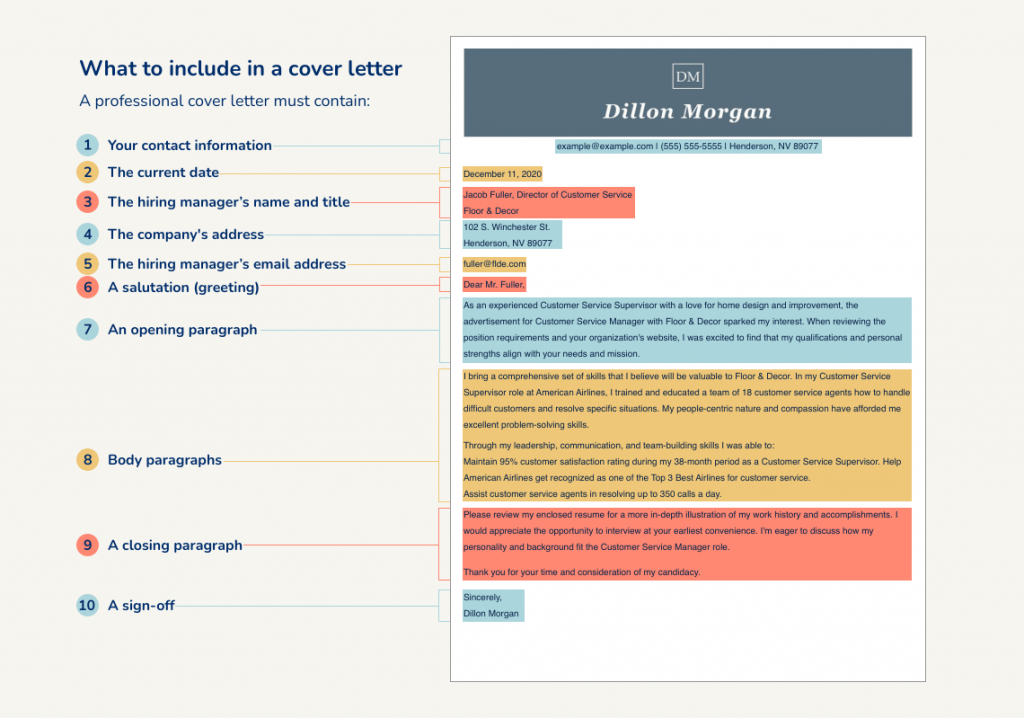
- Your contact information: Include your full name, address, phone number, and email address at the top of your cover letter, followed by the date.
- Potential employer’s contact information: If available, include the recipient’s full name, title, company name, and address.
- Salutation: Whenever possible, address your letter to a specific person or department (e.g., “Dear Mr. Smith,” “Dear Hiring Manager,” or “Dear [Company Name] Team”).
- Introduction: State the position you’re applying for and where you found the job listing. Express your enthusiasm for the role and briefly introduce yourself.
- Body paragraphs: Highlight two to three key qualifications that align with the job description and provide specific examples of your impact in past roles.
- Sign-off: End with a professional closing, such as “Sincerely” or “Best regards,” followed by your full name.
How to Write a Cover Letter for a Job
Write your cover letter by matching your experience to the specific job and explaining why you’re a strong fit. We’ll break down how to write a good cover letter, explaining how to structure each section and tailor your message to complement your resume.
STEP 1
Research the Company & Role
Company research is the foundation for answering one of the most important cover letter questions: Why this company?
Go beyond basic facts and learn what makes the organization unique—its mission, recent projects, culture, and the challenges it’s addressing. Use these insights to explain why your goals and values align with theirs, making your application feel intentional rather than generic.
Then, review the job description carefully to identify key skills, responsibilities, and priorities. Use this to map your experience to the role and guide what you include in your cover letter.
To identify what the employer values most:
- Review the company’s About Us page and mission statement.
- Check recent news or press releases for updates or achievements.
- Explore the company’s social media to understand its tone and culture.
- Look for keywords in the job description that describe ideal candidates.
- Identify how your skills and values align with the company’s goals.
STEP 2
Use an ATS-Friendly Template
Use one of our ATS-friendly cover letter templates, designed to ensure your application is easily read by applicant tracking systems (ATS). Choose a template that follows these principles:
- Single-column layout with clear section breaks
- Standard fonts like Arial or Calibri
- No text boxes, graphics, or columns
- Simple headings (e.g., Introduction, Experience, Closing)
- Keyword-friendly formatting aligned with job descriptions
These features help ensure your content is correctly scanned and ranked by ATS software.
Select a template that matches your industry and complements your resume design to create a cohesive job application that reflects your professionalism.
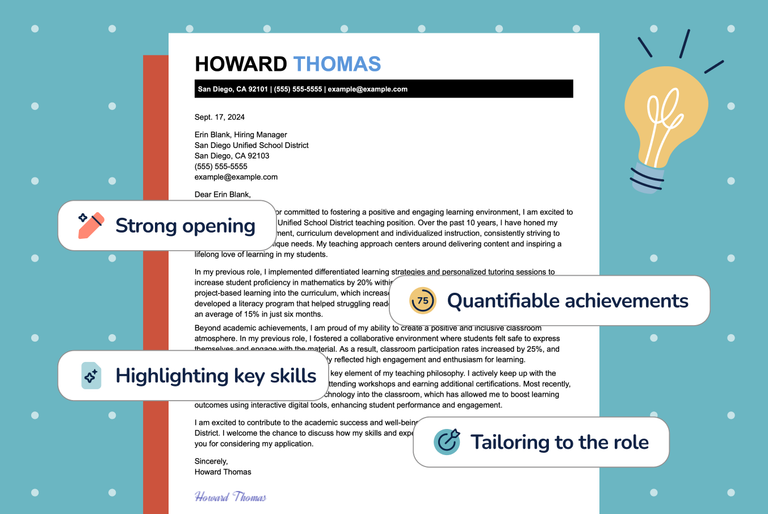
Opt for a standard cover letter format, like this example:

STEP 3
Create a Polished Cover Letter Header
Create a cover letter header that includes your full name, phone number, email address, and location (city and state; zip code optional) so employers can easily contact you.
Here’s an example of how to write a cover letter header:

STEP 4
Include the Recipient’s Contact Information
First, write the current date on its own line, then leave a line break before adding the recipient’s full name and title, followed by the company name and address. Here’s an example:

If the job description instructs you to address your cover letter to a specific person, follow the employer’s guidance and use the provided name for the recipient’s address.
STEP 5
Add a Personalized Greeting
The salutation of your cover letter sets the tone for the rest of your message. Whenever possible, address your cover letter to a specific person rather than using a generic greeting.
Using the hiring manager’s name shows that you’ve done your research and adds a personal touch to your application. Address them as “Mr.” or “Ms.,” avoiding titles like “Mrs.” and “Miss” to prevent assumptions about marital status.
Alternatively, you can use their full name for a gender-neutral approach (e.g., “Dear Alex Taylor”). Steer clear of informal greetings such as “Hello” or “Hi,” as well as outdated salutations like “Dear Sir or Madam” or “To Whom It May Concern.”
If you can’t find a name, it’s acceptable to use a general greeting, such as “Dear Hiring Manager” or “Dear [Department Name] Team.” See examples below for reference:
- Dear Lucy Garcia,
- Dear Ms. Lowe,
- Dear Hiring Manager,
- Dear Vice President of Marketing,
- Hi there!
- Hey Mr. Jones,
- Dear Sir,
- Samantha Martin:
STEP 6
Craft a Compelling Introduction
The opening sentences of your cover letter serve as your elevator pitch, so it’s crucial to clearly and succinctly convey why you’re the ideal candidate for the role. Explore cover letter introduction examples below to discover strategies for grabbing the reader’s attention.
Strategy 1: Assert Your Interest in the Company
One effective way to start a cover letter is to express genuine enthusiasm for the company by touching on how its values align with your own. For example:
I was excited to see that Tech Solutions, a company I admire for its commitment to innovation, has an opening for an experienced lead producer. With over 10 years of experience managing cross-functional teams and delivering high-quality projects on time, I am eager to bring my leadership skills and creative problem-solving abilities to your team. I am particularly drawn to Tech Solutions because of your focus on developing cutting-edge software solutions that streamline workflows for clients, and I am confident that my background in project management and digital product development aligns perfectly with this role.
Highlight your career story by emphasizing key accomplishments and experiences relevant to the role. Explain why you want the job at the specific company, showing your interest in the company’s mission and values. This personalized approach can set you apart from other candidates.
—Toni Frana, Career Expert
Strategy 2: Emphasize Job-Relevant Skills
You can also kick off your cover letter with a strong introduction that highlights your most relevant skills and experiences. Clearly articulate how these qualifications make you an excellent fit for the role, setting the stage for a compelling case. Here’s an example:
With seven years of experience in production for leading startup companies in Silicon Valley, I have developed in-depth knowledge of cybersecurity and cloud computing, along with hands-on experience in artificial intelligence. I am confident that my experience managing complex projects, coordinating cross-functional teams, and delivering high-impact solutions aligns perfectly with the needs of your team.
Strategy 3: Highlight a Measurable Accomplishment
Showcase your qualifications by mentioning an impressive award, honor, or measurable accomplishment from a past role or two. For example:
As director of Visit Mass, I developed and implemented tourism programs that led to a 30% increase in international visitors to Massachusetts in 2019. I am excited about the opportunity to bring my strategic planning and leadership experience to Global Travel Co., a company I admire for its innovative approach to expanding international tourism and creating unforgettable travel experiences. I am confident that my background in program development, marketing strategy, and stakeholder collaboration aligns perfectly with this role and will allow me to drive meaningful results for your team.
Strategy 4: Tell a Compelling Story
Tell a story about why you’re applying. Discuss how your passion and motivation have driven your career choices and how they align with the position and company. For example:
When I was a child, I spent my days in the city parks around my neighborhood, listening to birds sing and watching squirrels jump through trees. Those days instilled in me a passion for wildlife that has intensified over the years and, combined with admiration for the animal rehabilitation programs at Prospect Park Nature Conservancy, led me to apply for the Wildlife Technician position at the conservancy.
STEP 7
Write 1 to 3 Body Paragraphs
Write one to three body paragraphs that explain why you’re the best candidate for the job with specific examples. Here are a few key tips to keep in mind:
- If you have work experience in your target role or industry, showcase your key accomplishments and quantify your impact with specific results.
- If you’re applying for your first job, connect the new opportunity with a personal or school project, extracurricular activity, or internship.
- Highlight relevant skills from your experience and explain clearly how you can apply them directly if hired for the role.
- Demonstrate alignment with the company’s culture or mission, such as through volunteering or personal interests that align with their values.
- If you’re changing careers, focus on transferable skills that demonstrate your ability to succeed even without direct experience in the field.
Here’s an example of how to write the body paragraphs of a cover letter:
In my most recent role as a marketing coordinator at BrightEdge Solutions, I led the launch of a digital campaign that increased lead generation by 37% in just three months. I also collaborated with the sales and design teams to streamline content production, cutting turnaround time by 25% while boosting engagement across email and social platforms. My experience managing multiple campaign channels—from paid social to SEO content—has equipped me to step into a fast-paced role and make an immediate impact.
What draws me to WILCO is more than your reputation—it’s your commitment to belonging and creativity. I bring not only a strong analytical mindset but also a genuine passion for brand storytelling that resonates with diverse audiences. Whether it’s running A/B tests to optimize conversion rates or crafting messaging that reflects a company’s core values, I take pride in delivering marketing that’s both strategic and human.
STEP 8
End With a Call to Action
Your closing paragraph should reiterate your enthusiasm for the role and the company, summarize why you’re a strong fit, and express your interest in an interview. Keep it concise and professional, and include a polite call to action, such as thanking the reader for their time and consideration.
Below are a few examples of how to end a cover letter effectively, each with a slightly different tone.
Polished & Collaborative
I would welcome the chance to learn more about your upcoming initiatives and explore how my skills can support your marketing goals. Thank you for your time and consideration—I look forward to the possibility of contributing to the WILCO team.
Forward-Looking
Thank you for your time and consideration. I’m excited about the prospect of working for the Museum of Ancient History. I look forward to discussing what I learned in my year abroad as an English teacher and how I can apply those lessons to the docent role. Feel free to contact me any time during the week.
Sincere & Confident
I’m confident that my resume and portfolio demonstrate the technical skills and knowledge necessary to succeed in the lead designer role at Creative Ads, LLC. I’m excited about the opportunity and would be thrilled to meet with you and your team next week to discuss my ideas for your next campaign. Please contact me this week to schedule a convenient date and time.
Are you searching for remote jobs? Our sister company, FlexJobs, updates listings daily with verified remote jobs. Find full-time and part-time remote jobs with FlexJobs.
STEP 9
Sign Off Professionally
End your cover letter with a professional and polite sign-off. This demonstrates your attention to detail, professionalism, and respect for the hiring manager and the company.
Make sure there’s enough space between your closing and your typed name to leave room for a signature if submitting a printed letter.
See how to write a proper cover letter sign-off below (and what language to avoid):
- Sincerely,
- Best regards,
- Kind regards,
- Thank you,
- Yours,
- Take care,
- Cheers,
- Thanks!
STEP 10
Proofread Your Cover Letter
Before sending your cover letter, carefully review it for spelling, grammar, and formatting errors. Reading it aloud can help you catch awkward phrasing or typos. It’s also helpful to have a friend, mentor, or career advisor review it for clarity and professionalism.
A well-proofread letter demonstrates attention to detail and makes a strong, polished impression on hiring managers. Here are a few key areas to consider when reviewing your cover letter:
- Content and clarity: Ensure each paragraph clearly communicates your qualifications, relevant skills, and interest in the role, removing unnecessary words as needed.
- Accuracy and personalization: Double-check names, titles, company details, and any numbers or achievements you mention.
- Professional tone and formatting: Ensure language is polished and professional, avoid slang or casual phrases, and maintain consistent font, spacing, and margins.
- Call to action and contact information: Confirm your closing expresses enthusiasm for an interview, and that your phone number, email, and LinkedIn are correct.
Examples of Effective Cover Letters
Below are cover letter examples that demonstrate how to clearly showcase your skills, highlight relevant experience, and tailor your message to the company’s needs.
Samples for Popular Jobs
Use these samples as inspiration to craft a personalized, professional letter that stands out to hiring managers in your industry.
Registered Nurse Cover Letter

Security Officer Cover Letter

Car Driver Cover Letter

Samples for Unique Situations
These samples demonstrate how to write a cover letter for less common circumstances, such as career changes, first-time job seekers, or employment gaps.
No Experience Cover Letter

Career Change Cover Letter

Employment Gap Cover Letter

Use your cover letter to clarify any gaps or transitions in your employment history. Explain how these experiences have contributed to your qualifications and make you a strong candidate for the position.
—Dr. Jasmine Escalera, Career Expert
How to Write a Cover Letter: Tips to Stand Out
To stand out with a cover letter, focus on specificity, relevance, and clarity rather than generic statements. Here’s how to make a cover letter stand out in today’s competitive hiring climate:
- Demonstrate your fit and value. Clearly explain why you’re a strong match. Use specific examples of relevant skills, accomplishments, or results that align with the job description to show how you can contribute immediately.
- Follow application instructions carefully. Always adhere to the job posting’s submission guidelines, whether attaching a PDF, pasting in the email body, or completing additional materials. Missing details can result in your application being overlooked.
- Tailor your cover letter to the job. Avoid generic cover letters. Customize your content to highlight your enthusiasm for the specific role and company, and incorporate relevant keywords from the job description to demonstrate alignment with their needs.
- Use AI tools with caution. AI can quickly generate cover letter content, but it often sounds generic and repetitive. Use AI as a draft, then personalize with your voice, specific achievements, and company insights to ensure your application feels authentic.
- Avoid oversharing personal information. While explaining career changes or gaps is important, avoid sharing unnecessary personal details, such as political views, salary expectations, or unrelated hobbies.
- Focus on strengths, not gaps. Avoid apologizing for lack of experience. Emphasize transferable skills, accomplishments from volunteer work, internships, school projects, or other relevant experiences that show potential.
- Maintain a professional tone. Express genuine enthusiasm and interest in the position using polished, respectful, and consistent language throughout your letter.
What Should Be Avoided in a Cover Letter?
When you write your cover letter, common mistakes like being too generic, overly long, or unfocused can quickly weaken your application and cause hiring managers to lose interest.
Here are a few key mistakes to avoid when you create your cover letter:
- Repeating your resume: Your cover letter shouldn’t restate your resume line by line. Instead, focus on a few key examples that add context, show impact, or explain how your experience connects to the role.
- Overly long or dense writing: Keep your cover letter concise and easy to read. Long paragraphs and unnecessary details make it harder for hiring managers to quickly understand your value.
- Focusing on what you want: Avoid centering the letter on what you hope to gain from the job. Employers are more interested in what you can contribute, so shift the focus to your skills, results, and alignment with their needs.
- Spelling and formatting errors: Typos, inconsistent formatting, or incorrect company names can quickly hurt your chances. These mistakes suggest a lack of attention to detail and professionalism.
- Overusing AI without personalization: Relying too heavily on AI-generated content can result in a cover letter that feels generic or impersonal. Always revise and customize AI drafts to reflect your voice, experiences, and genuine interest in the role.
Get Results With Your Cover Letter
Whether you have years of experience or none at all, learning how to write a cover letter that stands out allows you to showcase your skills, enthusiasm, and fit for the role.
By tailoring your letter to each position, highlighting your achievements and skills, and maintaining a professional tone, you can create a compelling cover letter that grabs attention.
Take the time to proofread, refine, and personalize each letter, and you’ll increase your chances of landing an interview and moving one step closer to your next career opportunity.
Key Takeaways
- A cover letter introduces you to the hiring manager, expands upon the information in your resume, and explains why you’re an excellent fit for the role.
- Address the cover letter to the hiring manager. If you can’t find their name, then address them as “Hiring Manager” or address the department.
- Write a cover letter introduction that immediately grabs the hiring manager’s attention and compels them to keep reading.
- Use a professionally designed cover letter template to ensure your cover letter is formatted correctly and looks professional.
- Tailor your cover letter to your target job and use keywords from the job description that accurately reflect your skills and qualifications.
Frequently Asked Questions
How long should a good cover letter be?
A cover letter should be one page or less and typically three to six paragraphs long. Aim for about 250 to 400 words, including a brief introduction, body paragraphs that highlight your skills and accomplishments, and a concise closing paragraph. Being clear and to the point helps hiring managers quickly see why you’re a strong fit without feeling overwhelmed.
How do you write a cover letter with no experience?
You can write a cover letter with no experience by focusing on transferable skills, relevant coursework, and accomplishments from internships, volunteer work, or school projects.
Highlight strengths, such as communication, teamwork, or problem-solving, and connect them to the job requirements. Show enthusiasm for the role and company, and explain how your background demonstrates your potential to contribute and learn quickly.
Is it acceptable to write a general cover letter?
A general cover letter is acceptable in limited situations, such as job fairs, networking events, talent pools, or recruitment agencies. Still, most employers prefer a tailored cover letter for a specific role and company. In situations that require flexibility, create a simple cover letter focusing on your key skills, career goals, and overall value while keeping the content adaptable.
What five things should a cover letter include?
A cover letter should include a professional greeting, a strong opening that explains your interest in the role, a summary of your most relevant skills and qualifications, specific examples that show how you can contribute to the employer’s goals, and a closing statement that expresses enthusiasm and encourages further discussion. Together, these sections help personalize your application and highlight why you’re a strong fit for the position.
What is a good opening line for a cover letter?
A good opening line for a cover letter clearly states the role you’re applying for and immediately establishes your interest or strongest qualification. It should be direct, specific, and tailored to the company rather than using generic phrases like “I am writing to apply.”
Examples of strong opening lines include mentioning the job title and highlighting a relevant achievement, skill, or motivation that connects you to the role.
What are five common cover letter mistakes?
Five common cover letter mistakes include using a generic template, failing to customize the letter for the specific role, repeating your resume instead of adding new context, focusing too much on what you want rather than what you can offer the employer, and submitting a letter with spelling or formatting errors. Avoiding these mistakes can help your cover letter feel more personalized, professional, and effective in strengthening your application.
What makes a cover letter stand out?
A cover letter stands out when it’s tailored, specific, and clearly shows how your experience matches the role. Instead of generic statements, it should connect your skills to the job description and demonstrate genuine interest in the company.
Strong letters include concrete examples of achievements, align with key requirements, and use relevant language from the posting. A confident, focused tone and clear motivation help reinforce your fit and make your application more memorable.
Can AI help me write a cover letter?
Yes, AI can help you write a cover letter by generating drafts, organizing ideas, and improving clarity and tone. It’s especially useful for getting started quickly or refining structure and language.
That said, AI-generated content can be generic, so it should always be edited to include your own voice, specific achievements, and details about the company. Used well, AI is a support tool—not a replacement—for personalization and authentic storytelling.
What are the three golden rules of writing a cover letter?
The three golden rules of writing a cover letter are to customize it for each position, focus on how your skills and experience can benefit the employer, and keep it clear, concise, and professional. A strong cover letter should show that you understand the company’s needs, highlight your most relevant qualifications, and provide additional context beyond your resume. Following these principles helps create a more targeted and compelling application.
How We Reviewed This Article
Since 2012, we have helped more than 11 million job seekers. We want to make your career journey accessible and manageable through our services and Career Center’s how-to guides and tips. In our commitment to bring you a transparent process, we present our Editorial Process.
Rate this article
How to Write a Cover Letter


Elizabeth is a Certified Professional Resume Writer (CPRW) and a member of the Professional Association of Resume Writers & Career Coaches. She is committed to helping job seekers navigate the job market and succeed in their careers.
More Articles by Elizabeth Muenzen, CPRWShare this page
 Add MyPerfectResume as a preferred source on Google
Add
Our customers have been hired at:*Foot Note